

From Kitty Hawk to Artemis II
It has taken 60 years to repeat the Apollo 8 mission. Where has all the aerospace innovation gone? With today’s Artemis II launch, I was thinking about how far aerospace has come since Orville and Wilbur's flight at Kitty Hawk, and how far it can still go.
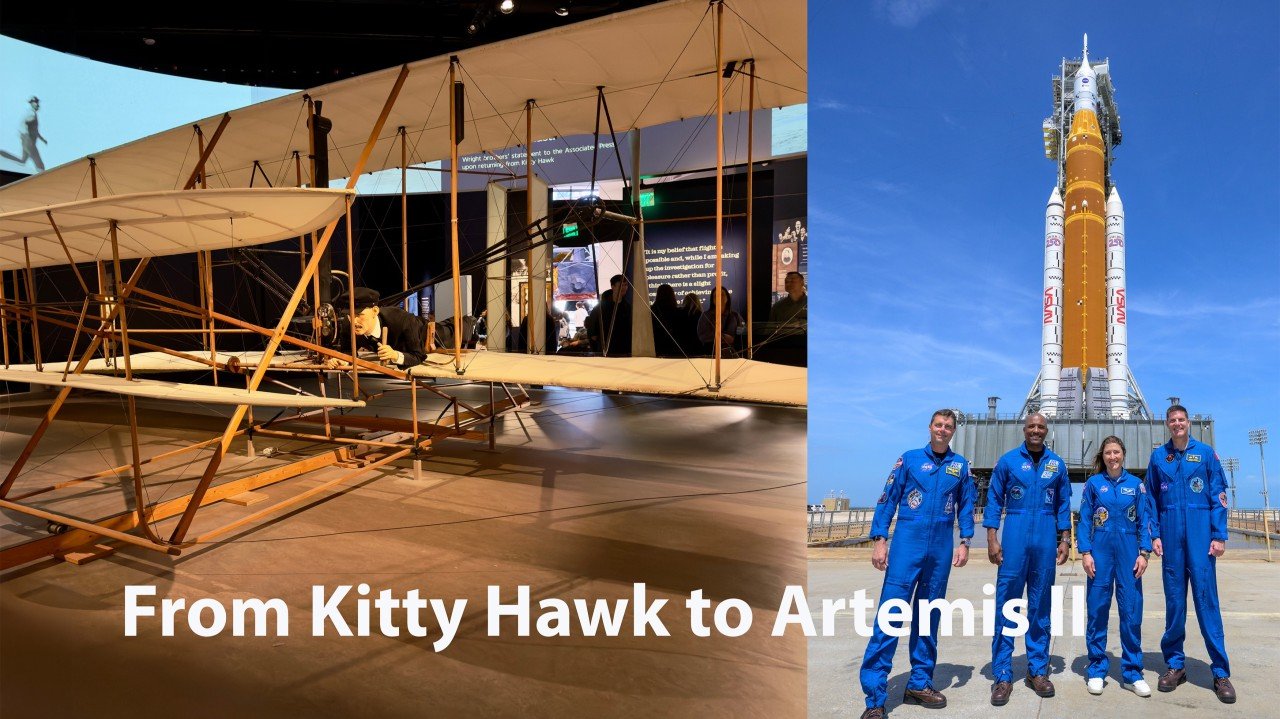
Since that day in North Carolina, new discoveries have driven the aerospace industry to incredible heights. In the following 60 years, we moved from cloth-covered wooden wings to jet engines and rockets. Crossing a beach turned into crossing an ocean, and leaving the ground became leaving the planet.
By the end of the 1960s, we put a man on the moon, a Mach 3+ spy plane in the air, and developed a supersonic transport. The outlook for the future of aerospace pointed toward interplanetary space travel and technology to fly aircraft higher and faster. Looking back from 2026, however, that is not exactly what happened. If today’s Artemis mission is successful, it will have taken us almost 60 years to repeat the Apollo 8 mission. The SR-71’s last flight was in 1999, and the Concorde was grounded in 2003. Is aerospace innovation stalled?
The well of discovery that Orville described didn’t dry up in the second six decades; it just took a different path. Humans did not explore other planets; robotic probes did. Spy planes did not become hypersonic; weapons did. Commercial air travel did not get faster; it got cheaper and longer range.
What aerospace discoveries should we look forward to in the next six decades? Predicting the future requires understanding the past. Looking back over the last 120 years, there were four key factors driving aerospace discovery: world events, politics, economics, and technology.
World events like WWI gave us aircraft with metal frames, enclosed cockpits, and integrated machine guns. WWII saw propulsion move from piston-driven engines to turbojets. And today, the wars in Ukraine and Iran have validated the need for drones and mass production.
Sputnik had little practical utility, but the geopolitical impact of that small sphere did more to motivate the U.S. space program than anything before or after. How much quicker did the U.S. land on the moon because they were motivated to beat Russia?
Wars end, and politics change, but aerospace companies will always want new products to sell. Passengers willing to pay a premium to fly quickly across an ocean brought us the 707 and eventually the Concorde. New companies with new rockets dramatically reduced the cost of lifting things into orbit. And combat drones can protect human pilots, but they are also far less expensive to build and maintain than crewed aircraft.
Advancing technology in aerodynamics and propulsion drove much of the innovation in the first 60 years of aviation. Propeller-driven biplanes became B-52 bombers with eight turbojet engines.
Advances in electronics and software drove innovation in the following six decades. Aircraft can talk to satellites to navigate. Reusable rockets can return to their launch pad. And drones can cross the sky or drive across a planet without a pilot at all.
World events, politics, economics, and technology will continue to drive aerospace discovery over the next sixty years. We read about drones and wars every night on the evening news. There are plenty of world events, politics, economics, and technology driving the development of aerospace for defense. I wrote about this in a recently published column in Aviation Week & Space Technology: Do F-47s and B-21s Have a Place in Drone-Filled Skies? However, I want to focus on space in the rest of this article.
The US was racing the USSR to space in the 50s and 60s. Today, the race to put humans back on the moon is between China and the US. The target this time is not just to go for a few days, drive a moon buggy, and bring back some rocks. This time, both countries want to establish a permanent human-inhabited base there. The first country to move into the lunar neighborhood will have a distinct advantage.
Humans have continually inhabited low earth orbit (LEO) in the International Space Station (ISS) for the last 25 years. Other than the power the ISS gets from its solar panels, nearly everything else consumed on the ISS must be shipped up from Earth. That is an expensive and difficult task when the ISS is orbiting just 260 miles above the Earth, but it can be done. The Moon is more than 900x farther from the Earth than the ISS. It will be somewhere between impractical and impossible to supply all the necessary lunar base resources needed from Earth.
One of the essential resources we will need on the Moon is water. If we have water, we can drink it, grow food with it, make oxygen to breathe, and hydrogen for fuel. A lunar base is only possible with a local source of water. Fortunately, recent lunar missions have found water in various places on the Moon. The largest concentrations of water are in craters near the poles – places we call permanently shadowed regions (PSRs). Places where the Sun never shines. Estimates have shown these PSRs contain 600M tons of lunar ice. Plenty of water to sustain a lunar colony.
The country that controls the poles and the PSRs will be the country that can most easily establish a base on the Moon. This is why China set a goal to land humans on the Moon by 2030. They want to own the lunar ice on the poles.
Enter Artemis: NASA’s Artemis program traces its beginnings to the Constellation program launched in 2004 with the goal of returning humans to the moon by 2020. After some twists and turns, the program has become Artemis with a goal to send humans to the moon by 2028. We are eight years late, but it’s still an aggressive goal. The US does not want to get Sputniked again – this time by China.
Aerospace innovation didn’t die in the last sixty years. It just took some detours we did not expect in 1969. While it may seem that Artemis II is simply a repeat of Apollo 8. It is far more than that. The planned launch of Artemis II on April 1, 2026, is the next big step toward securing a claim on lunar ice, so the US can establish a permanent outpost on another world. This is politics, economics, and technology all working together to drive the next big thing in aerospace exploration.
Humanity has flown from a Kitty Hawk beach to a giant leap for mankind on the moon. Years after the Wright Flyer, Orville reflected on all he and his brother had accomplished: “Isn't it astonishing that all these secrets have been preserved for so many years just so we could discover them?” The Wright brothers could not have imagined what humanity would do with their invention. Orville was right when he said it is astonishing that all these secrets were preserved so we could discover them. But what is truly astonishing is how many more secrets remain to be discovered on our way to the moon and beyond.